
Teaching history in our homeschool is more than just reading about the people, places, and events that have shaped our world. There are two key extras that play important roles in connecting the people and places of history to each other throughout the year – a history timeline and a markable map. They may seem like just two small extra steps, but these tools help my kids process and retain what they learn through their history books. Using a complete history curriculum makes including these tools a simple part of our homeschool routine.

The Homeschool History Timeline Book
A timeline for homeschool history is a key component of any history curriculum. Before we decided to try BookShark, I was eyeing the huge timelines that you hang on the wall and the ones made with tri-fold boards. They sure looked like great ideas, but thankfully, BookShark’s curriculum came with something different. Their timeline is a spiral bound book that fits nicely on our bookshelf.
Six years later, I’m SO glad that we don’t have a massive timeline taking up valuable wall space or huge tri-fold boards for different time periods. The Timeline Book is far more reasonably sized, and the same book is used year after year. This helps my kids connect the different historical events and people they’re learning about to those they’ve learned about in previous history levels. They can see at a glance important historical events that happened around the same time but in different parts of the world.
Related Post – Why Veteran Homeschoolers Love All-In-One Curriculum

Tips for Using the History Timeline Book
- Each student should have their own Timeline Book – especially if they’re doing different levels.
- When assembling the BookShark binder, cut apart the timeline figures and paperclip them to the Instructor Guide weeks that they’ll be used. The Timeline Figure Schedule in Section Three of the Instructor Guide is a quick way to see which figure goes where.
- Some people and events have dates that span a long period of time. We like to have the people noted during the time when they ruled or accomplished what it was they’re known for.
- For events that span a long period, we like to use the end date as a guide for where to put them in the Timeline Book.
- Not all events and people will have stickers. We like to keep the stickers below the mid-page line which keeps the area above clear for writing.
- Timeline activities are not only found in the history reading assignments. As kids get older, you’ll also find them with the read aloud and reader assignments. Be sure to look under those headings in the Instructor Guides.
Related Post – How to Organize BookShark Materials
Using the Markable World Map for Geography
A large markable wall map is also a key component of any history curriculum. We don’t have a lot of wall space in our homeschool area, but BookShark’s wall map has earned its own prominent place because it gets used everyday. This is a markable map that my girls label with the countries, states, cities, land masses, oceans, rivers, and mountains that they learn about in the BookShark Reading with History programs.
The geography portion of BookShark’s history program is built from the many books in each program level. Geography isn’t learned by rote memorization. Instead, it comes together with history organically. It’s taught by connecting the people, places, and events we read about to locations on the map. As the year goes on, my kids get to see all the places we visit through stories. Even though the focus is not memorization, kids naturally start memorizing the names and locations of countries, states, and cities.
Related Post – Teaching History with Engaging Books
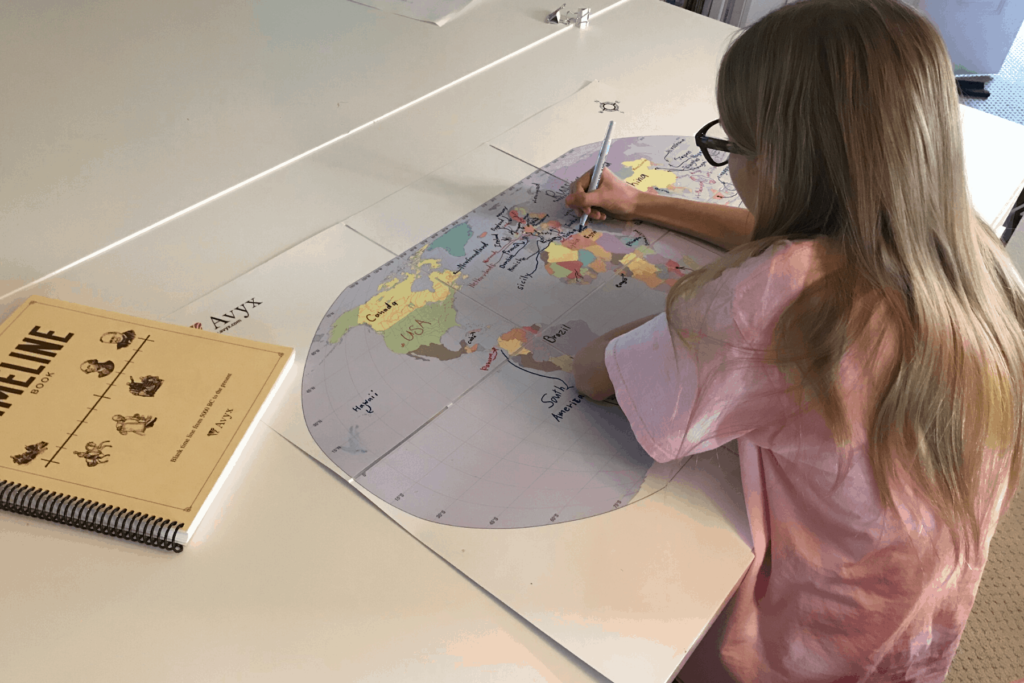
Tips for Using the Markable Wall Map for Geography
- Each student should have their own Markable Map if they’re doing separate levels. Due to space, we only hang up one map.
- To hang it, put two thumb tacks in the wall positioned where the top corners will be. Attach a binder clip to the map in each upper corner. Hang the binder clips over the thumb tacks. Now, you can easily take it down to write on it.
- Each location is noted in the BookShark Instructor’s Guide with coordinates to help you find it on the Teacher’s Map Key. For younger students, help them use the coordinates to find it on the Teacher’s Key before they try to find it on their big map.
- Each time my kids add to their maps, we review nearby areas that we’ve read about in their books. This helps them connect locations and events to each other, and it also helps them with memorization.
- Map activities are not only found in the history reading assignments. As kids get older, you’ll also find them with the read aloud and reader assignments. Be sure to look under those headings in the Instructor Guides.
Related Post – American History Lap Books
A homeschool history curriculum just isn’t complete without a history timeline and markable wall map. These extras help kids connect the people, places, and events they’re learning about throughout the year. Since the same timeline book is used year after year, they can connect what they’re learning now to what they’ve learned in previous years. Using a complete history curriculum makes these extras very easy for us to incorporate into our homeschool routine.

[…] Related Post: Homeschool History Extras You Don’t Want to Skip […]